

TEST PROTOCOL for Cattle USING The Eggzamin™ Kit
We have designed a testing protocol using our Small Ruminant and Camelid kit that can be applied to cattle feces in order to conduct fecal egg counts. This protocol will allow you to determine the level of parasite burden without costly shipping and laboratory fees that are typically associated with parasite monitoring. This kit will allow you to:
➔ Quickly administer a dewormer to individual animals based on a treatment threshold (which will reduce/slow the progression of anthelmintic resistance on your operation)
➔ Test the effectiveness of your chosen dewormer. This can reduce costs to you, as well as maximize profits over time.
➔ Make important culling and breeding decisions based on parasite loads.

This modification is indicated for calves under 2 years old and mature bulls.
Mature female cattle over 2 years old generally do not carry high enough worm burdens for the McMaster Method to accurately detect. For mature female cattle, a direct fecal flotation is recommended to determine the accurate fecal egg count.
TESTING PROTOCOL FOR CATTLE
The protocol using our Small Ruminant and Camelid kit begins with CATTLE feces sample weight of 3 grams.
With this protocol, each egg counted will be representative of 13 eggs. When you determine the total number of eggs, you will need to then calculate the eggs per 1 gram of feces (EPG).
For example, if you get a total count of 50 eggs in the McMaster slide, then the calculation will be:
(Side 1 + Side 2 =50 eggs) × 13 = eggs per 3 grams feces
Example:
50 eggs × 13 = 650 eggs in 3 gram sample
Then: (Eggs found in slide) ÷ (Starting feces weight) = Eggs per 1 gram (EPG)
Example:
650 eggs ÷ 3 (grams of feces) = 216. 6 EPG
Note: You always want to round up to the next whole number so the total number of eggs for this fecal sample is 217 EPG.
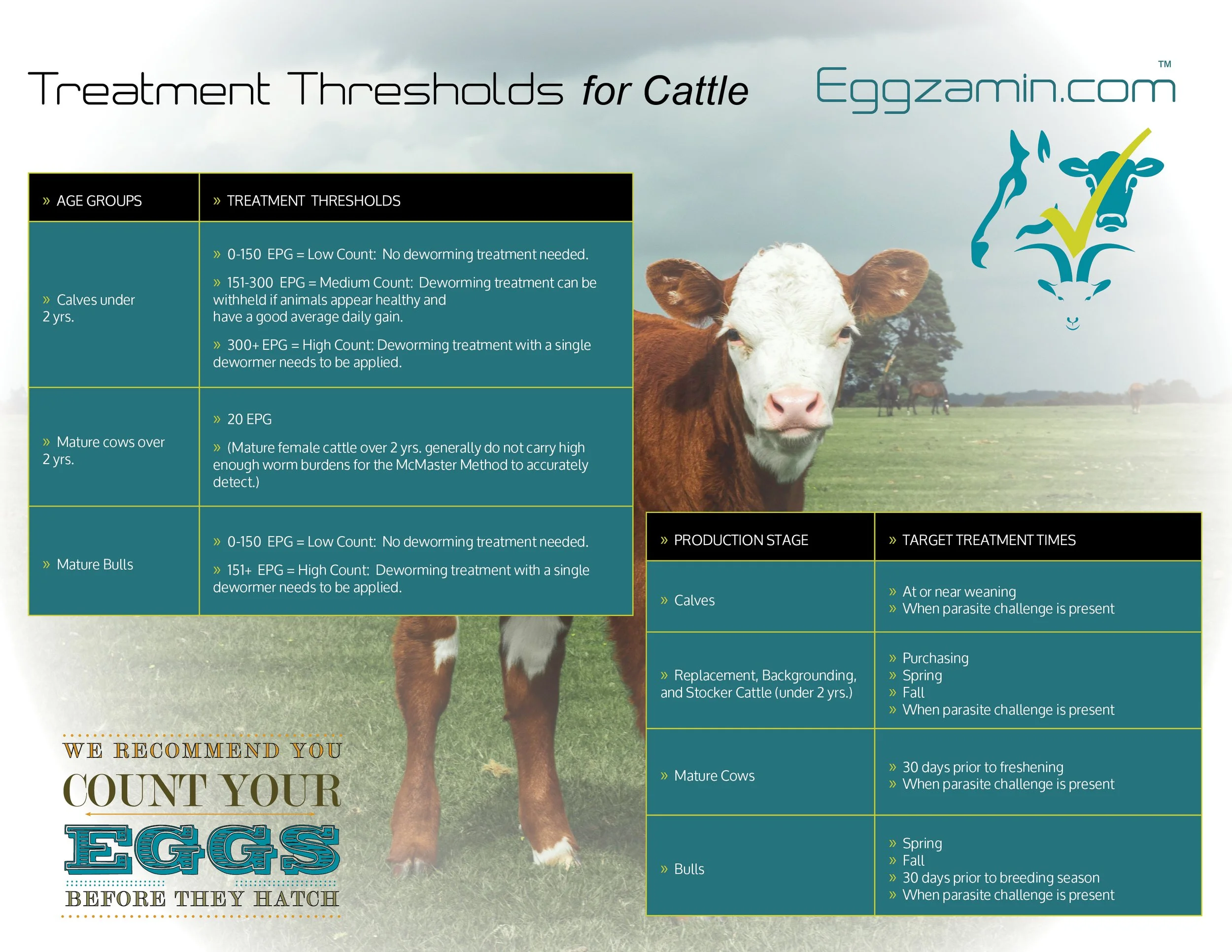
Treatment Thresholds
Calves under 2 years old:
0-150 EPG = Low Count: No Deworming Treatment Needed
151-300 EPG = Medium Count: Deworming Treatment can be withheld if animals appear healthy and have a good average daily gain
300+ EPG = High Count: Deworming Treatment with a single dewormer needs to be applied
Bulls:
0-150 EPG = Low Count: No Deworming Treatment Needed
151+ EPG = High Count: Deworming Treatment with a single dewormer needs to be applied
***Any time a Dewormer is given, a Fecal Egg Count Reduction Test should be conducted to ensure that the treatment was effective.